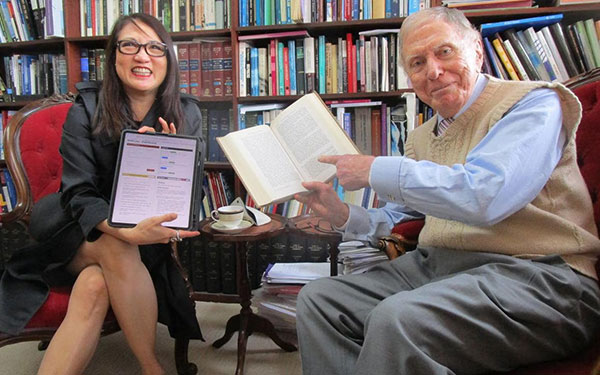

Laina Chan first met former High Court justice Michael Kirby in 1994, when she worked for him for seven months at the NSW Court of Appeal.
They became good friends and, more than three decades later, she recalls sitting in the now retired judge’s chambers on Phillip Street in Sydney.
That day in August last year, Kirby had what he described as a “Madame Curie” moment, in deference to two-time Nobel prize-winning scientist Marie Curie.
Kirby was holding in his hands the judgment of the landmark Mabo native title legal case from 1992.
On the screen of Chan’s iPad was a summary of the case, not written by a junior associate, but generated by an artificial intelligence system Chan had built from scratch.
Kirby read it line by line, pointing from the judgment to the screen and back again. “This is correct, this correct, this correct. All of this is correct!” he exclaimed. Then he turned to his secretary and said: “We have to photograph this moment.”
They did.
That day was deeply symbolic for Chan, founder and chief executive of MiAI Law, the legal artificial intelligence venture she built after teaching herself to code well enough to write more than 13,000 lines of it herself.
Kirby has publicly endorsed the AI approach, saying: “This is the way of the future and it is great to see an Australian at the forefront.”
MiAI Law’s research and risk management system extracts precise legal reasoning, or ratio, from case law, rather than secondary sources. The firm raised $2m from investors at a $25m valuation last year and Chan is positioning for a far larger raise as MiAI Law works toward a valuation of $100m.
Chan arrived in Sydney from Malaysia at the age of 15 and attended an all-girls private school where she finished dux.
Her father had worked in Kuala Lumpur for an Australian company that made toothpaste tubes across Asia before being transferred to Australia as finance director.
Chan completed a dual honours degrees in pure mathematics and law from the University of Sydney and a certificate of management excellence from Harvard Business School Executive Education.
She was a lawyer at firms such as MinterEllison and Phillips Fox before becoming a practising barrister in 2004.
Twenty-two years on, she is still working at the bar, but her passion has become MiAI Law.
“Judges using our system say we can find cases that Westlaw or Lexis cannot find, that their associates cannot find, and that counsel in the cases cannot find,” she says. “The difference is that we have extracted the key legal principle, the ratio, from every single case. I wrote the code to do that.
“Silks are saying our reports are better, cheaper and more accurate than what juniors give them. Judges say we are accurate as well. That is our secret sauce.”
But unlike most start-up founders, the piece of infrastructure Chan is most protective of is not the product road map. It is herself.
She still personally codes the system’s legal reasoning layer, which means the firm’s progress runs, quite literally, through her own cognitive bandwidth.
“I do not see health as something separate from my life,” she says. “I see it as infrastructure. I cannot do the work I do unless I exercise. Exercise keeps my brain clear.”
Chan took up masters rowing seriously in her 30s, working her way from an eight to a quad, then a double, and finally a single, training under former Australian representative rower Laura Carter. It nearly ended her.
Rowing to Leichhardt one morning, a UTS rower veered off the shoreline and struck her in the back with an oar.
Her chiropractor later told her the blow, landing while she was in tension, had locked up that side of her body. Months later she raced anyway, at the masters regatta.
“I twisted myself into a pretzel and developed terrible sciatica. I could not walk more than 20 metres without pain,” Chan says.
Full rehabilitation took close to eight years before she fell skiing on a double black run in Aspen and tore her infraspinatus and supraspinatus, two key shoulder muscles.
Her rowing days were finished.
What has replaced it is deliberately low-impact. Chan walks home from work most days, “usually at least 7km”, using the time to listen to Harvard Business School material or audiobooks by Jeffrey Archer or John Grisham.
Weekends are for pilates and yoga to build core strength, mobility and injury prevention.
All of which builds toward her single annual fitness goal: a month of skiing every winter, gravitating toward technical double black terrain, always with an instructor.
But the newest addition to her health routine is more unconventional.
In March last year, through a contact in Utah, Chan was offered two ccs of stem cells, infused intravenously by a nurse after a session with a chiropractor practising neuro-emotional and kinesiology techniques.
She was hesitant about putting “something foreign from an umbilical cord” into her body but went ahead with the injections in the US.
By October, travelling constantly for work, she realised she had not been sick once.
“These injections are fundamental to my productivity,” she says, “and therefore to my business.”
Chan’s appetite for pushing through discomfort, physical and professional, traces back to her parents.
Her father died a decade ago from Lewy body dementia.
“The last eight months were the worst. By the end he could not swallow. It was just terrible,” Chan says.
Watching that decline gave her a private deadline: whatever she still needed to do with her career, she resolved to have done it by 75, before her own brain might fail her in the same way.
It was her father, who had insisted back in Malaysia that his daughters be allowed to argue and speak up for themselves, who shaped her personality.
But she believes her resilience came from her mother, who was “always a fighter”.
That combination was tested repeatedly across two decades at major law firms where, Chan says, she was pushed to conform because she did not fit the mould.
“I do not know what it is about you,” a colleague once told her, “but there is something about you that makes people feel the need to crush you.”
She did not bend. She moved to the bar instead and is now applying her passion for artificial intelligence to an industry sceptical that a barrister with a maths degree could out-research Westlaw and Lexis.
“Despite the attempts to crush me, I am still here,” she says.
Please see the original article: Here